

Dr.N.Damodar Shetty was revisited when he attained the age of superannuation in 2012. Quite probably, in a subtle way, ‘recognition’ was bothering in some corner of my mind when I was wondering about the relevance of what all we do for the society. Maslow, while speaking on human goal speaks about it and extends it to self-actualization. Recognizing essential goodness of human being cannot be self-managed, but spontaneously looked at passionately or dispassionately. ND deservingly got it in abundance. The smile on his face became broader, chest protruded, confidence enhanced, the commitment rejuvenated and the society is benefitted. Dr.N.D.Shetty was described aptly as a multi task personality of Mangalore by famous cine director Nagathihalli Chandrashekar. Being born in Kasargod District, the cultural affinity with Karnataka must have inspired him to imbibe kannada as a value. He passionately loved kannada, breathed kannada. Instead of fuelling the feud, when Caught between two cultural identities, he exploited the opportunity to bring harmony. He chose teaching and literature for reaching out to the society. His contribution cannot be limited to any one form of literature but capaciously confined to theater, fiction, poetry, cinema both in small and big screen and translation work. This multi-faceted person was perceived to be a great teacher, writer, actor and organizer.

No one calls him N.D.Shetty. He is Naikapu ( we took the liberty of calling him occasionally Naayi (dog) a pause, then Kaapu Damodara) Damodar Shetty fondly known as “NaaDaa”. His involvement in drama made him ‘Dramodar Shetty’ and for some ‘Damu’. Let us make it sweetly “ND”. He can never sit in one place, always on the move. When he directed the drama, ‘Oduvavaru” (Runners), he became “Naadaa always on the run”. He enjoyed it My description may sound arrogant. But my association of more than 30 years as a friend emboldens me to express the views the way I want. Frankness or hypocrisy becomes too judgmental. Love and affection cannot be showered on a person just like that. It is not merely a farewell or a felicitation. It is engineered to tell people who matter and around you that the person is worth it. Someone has opened our eyes to contemporary teaching and issues of literature and we are grateful for enriching our lives. The question is whether ND did it and my answer is in the affirmative.

Contributions and achievements of ND are not based on imaginations but on life experiences. The way you grew up enables you to look at life from different angles. ND grew up from a very ordinary background. The only attention he got in his childhood days was that he was the youngest in the contingent of ten. He must have experienced some affection and love from his elders in the pain of acute poverty. Look at the cultural diversity of that family. Father was a weaver, brother became a renowned yakshagana artist later turned in to a politician of a right wing party and other brothers got in to business or professions. More interesting is that ND had a sir name of Shetty, but his father was a ‘Chettiyar’, three of his brothers a ‘Rao’ and may be others without any sir name. People ascribe an identity to you based on your sir name. But here they were utterly confused. Not many had the courage to ask him to which caste or creed he belonged. This itself added grace and poise to his personality. The affectionate mother and sisters inspired him to look beyond. The transformation from economic wealth of his grandfather to misery in the changeover from one generation to another infused an inner urge in him to come up in life. He was activated by thoroughly exposing to sports, games and cultural activities in school days. The family trait ultimately was instrumental in bringing out from him the best teacher and litterateur
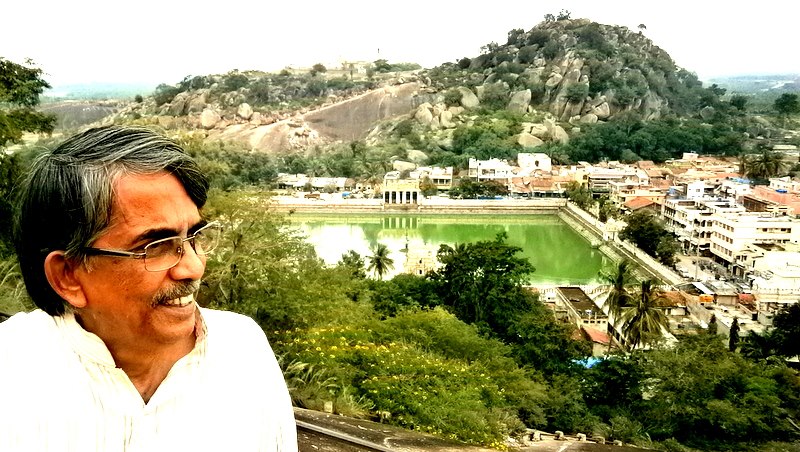
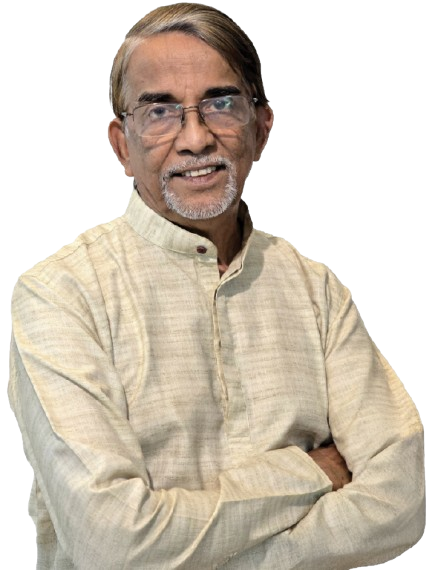
ND is a friend at first sight. His mercurial personality fascinated you. Composed humour makes you comfortable. Whenever he meets me he would start singing,” Bagilanu teredu seveyanu kodo hariye..ss…narahariye..sss” or “narari gode hatti parari..” But he always respected me as a leader of teachers. His jovial nature did not spare anybody: for Dhundiraj, renowned short poem writer, he would call him “Dhum” or “Dhumskara instead of Namaskara”. Something was there for everybody. His physical personality was well described by the highly respected Octogenarian Sri Erya Laxminarayan Alva thus: Hair combed which parted on the right but something not controllable even if combed, oiled, watered but some falling on the forehead, somewhat round face, eyes appearing bigger than the face, lager spectacle, always a broad smile on face, little longer Nehru Kurta, beneath it a pant, an oscillating long shoulder bag, curious stare, always on the feet, no speed breaker in uttering words, little laugh in every talk, is all that can be featured as first hand sight. But the internal sight is much vaster with deeper sentiments.

ND was a great teacher. There was a great kannada legacy transferred to ND at St.Aloysius College. Kannada department had greater traditions built by doyens like Muliya Thimmappayya, Tekkunje Gopalakrishna Bhat, Sediyapu Krishna Bhat…list goes on. It was a greater challenge to live up to that. ND must have felt at his retirement that he did not let them down. Instead the heritage was extended. He brought in a cultural explosion. Music, drama, literary competitions, seminars, drama festivals, workshops, film appreciation programmes and so on. Students and the general public had the great fortune of experiencing renowned performers from all over. Aloysius became a cultural center.
He also built an impressive departmental library with nearly 5000 books. He founded a scheme, “Pustaka Jolige” (begging bowl for books) Not just the books within the glass cover but motivated many to have a taste of books and you know book reading habit is infectitious. We need to revive that tradition among our younger generation.
Students just loved him. It was a treat to watch his students so caringly, lovingly cajoled, fondled. Both in and outside the class the scene was the same. It was really amazing for me. I was always struggling to have such a relationship with my students with limited success. Teaching-learning is always wonderful when you are resourceful and your disciples are listening to you. But it doesn’t mean that ND always smiled. Beneath his smile there was firmness in correcting the undesirable behavior. Language class for many was relaxing time. Teachers were struggling to get the attention leave alone engrossing them or motivating them. Some were singing, some were shouting; all cannot sing! A lot of strategic gimmicks. But ND succeeded in making them accept and respect so much so that some of his students even washed his car, served in domestic requirements without any grudge but with love &affection.. Guru-Shishya (Teacher-Student) tradition was not just symbolic but a model for many of us. His experience of teaching at different levels (He was a secondary school teacher for four years prior to his college career).
ND did not confine himself only to college as he wanted to work capaciously. He was instrumental in reviving, building many institutions to facilitate contemporary literature and theatrics. His enormous advantage of knowing both kannada and Malayalam made him translate great art pieces to each language. In the process he became a writer, columnist, organizer, an actor, a resource person and so many in one. No exaggeration if he is described as a multi-tasker.
It is not easy to take people along with you. Just as building institutions is important sustaining them is also a greater responsibility. People accept you for your principles and practices. When he was associated with Prasanna in building “Samudaya” and through it staging the drama,”Mareechana Bandhugalu” people took him to be a leftist. His views on contemporary politics and the event of his brother becoming an MLA of a right-wing party, he was construed as a rightist. This is the problem for many. Throughout, I have faced such dichotomous outlook of people. But ND was above such ‘isms’; he only believed in humanism. That is why with so much propensity of concern he could depict an ordinary person.
His passion for theater was more realized through “Bhoomika” an organization he started with Sri Erya Laxminarayan Alva. It became a platform for directing & producing several dramas and also organsing shows of the play produced by eminent institutions like Neenasam, Heggodu, Sagar. ND cajoled many young persons to write. “Vedika” became jumping point for students to write in different forms and forums. It also published a few books. What started as a forum for promising writers in fact transformed them as prolific writers.
ND was a savior of declining cultural fervor in Mangalore. Educationist and Research Scholar Prof.B.A.Vivek Rai feels that Kannada literature and culture in Mangalore satiated its desire through different people from time to time. But it needs a process which he calls as “Dohala” process (process of rejuvenation) lest kannada tree does not bloom or blossom in to flowering. ND is prominent for watering, manuring kannada tree to blossom. Prof.Rai feels that ND contributed enormously in re-building harmony between kannada-malayalam through great translation work.
What stands out as an extraordinary organizing skill of ND was manifested in “DASAJANA” ( A cultural organization named through the first letter of the names of four friends-Damodar Shety, Satyanarayana Mallipattana, Javali Nagaraj & Narashimhamurthy). The emaciating cultural scene of Mangalore got a face lift through Dasajana. Although the organization was symbolically in the name of four persons, there was no dearth of people associating with it. Many people wanted their names to be added unsuccessfully. But nevertheless the organization did yeomen services worth the name. Little over a decade (2000-2011) Dasajana was in news in staging/exhibiting a play, book release, felicitation, social activity including even conducting very meaningfully condolence meetings for those who lent their service for mother kannada. People feel vindicated not when they start something but when they end something with many accomplished reflections. ND was an integral part of several organizations throughout and everywhere he has better things to say. Dr.Mohan Alva, the creator of “Alvas” and ND were meeting as rivals in literary competitions. Perhaps the extraordinary ability of Dr. Alva of transforming defeats in to victory fascinated him. ND simply adores Dr.Alva as an institutional builder with a very strong self-esteem, ambition and determination. ND became a part of Alvas. Eminent writer, critique Dr.Hampa Nagarajayya calls ND as “Sopajna Chintaka” (Comprehensive Thinker). The simmering frustration that literary meets are becoming fairs; learners have no food for thought; sessions become sandys; past is presented through the veil of present; past remniscenced with glorification; more references to the procession, food arrangements and the grandeur of dais; People craving for a debate on a contemporary issue which dissipates as the meet is over, compelled ND to think differently. He documented the need for a paradigm shift in organizing Sahitya Sammelana through documentation “Hobidiru”- an effort to revisit kannada literature over a century (1804-1905). ND was the editor of this publication. Hombidiru became a ‘prelude to ‘Nudisiri’. Alva being an innovator and a disciplinarian, a new dimension was given to “NUDISIRI” widely acclaimed as a meet with purpose.
ND’s ability to assume different roles as a poet, writer, dramatist, translator, columnist have been critically assessed by many eminent people. Poet Sri Subraya Chokkady, while commenting on the poems written by ND, calls him a poet with sensitive mind. “odeda muttugalu” (First collection of poems), “England Kavanagalu” an expression on his travel to England is appreciated for its cultural assimilation with India. ND’s “Desha Bhakti Geethegalu” collection of patriotic songs and “Haadu manave Haadu” depicts his ability to get in to light music also.
CNR (Dr.C.N.Ramachandran) expresses his affection by terming ND as a multi talented person. It is a privilege for ND when CNR examines ND’s three novels: “Mattade(collection of short stories), “Suluvinolage”(Novel dealing with failed married life) and “Saradi” (Novel based on conflict of culture in a globalised world). CNR’s comment that journey is more important than reaching the destination is what ND believes in.
Probably the significant contribution of ND is in the field of translation. “Ashwathaman” (a radical novel of Madamb Kunhikuttan), “Devara Vikaralagalu” (composition of M.Mukundan-Daivathinde Vkruthigal) and Narayan’s “Kochcharetti” (story of tribal people) are the three master pieces which not only deserved the appreciation for not deviating from the original authors’ wishes but adding value to it. ND was never after awards. But the awards were after him. “Devara Vikaragalu” got him Karnataka Sahitya Academy award and also Kendra Bhasha Bharathi Sanman.
ND’s thesis “Muddanana Shabda Prathibe” was not an ordinary research work for a degree but an exposition of Muddana’s words in enriching kannada language. ND’s column in Prajavani News paper, “Tenkanada Suligali”, for over five years, introduced coastal Dakshina Kannada in his inimitable style. He derived pleasure in writing, directing and staging several kannada plays. Never believed in sitting at home quietly. He even acted in many films and television serials. People were wondering where does he find time unless there are greater sacrifices not shared. Nadoja Nissar Ahmad finds ND as someone above ordinary people’s tall claims with limited ability and acclaims the knowledge internalized by the person as something endearing to your heart. The talent did not go unnoticed. He got the recognition from all corners and his services were used even by Government of Karnataka as an expert in preparing kannada text books at different levels of education. What more you need than eminent thinkers, writers, poets acknowledging, family and friends proudly sharing, students admiring and the society benefitting.
I will end on a personal chord. As a friend, I never wanted to avoid him. He was not able to actively involve in my teacher movement activities. He was always my well wisher. When I thought why marriage and other family functions should not be used for cultural expositions, ND facilitated it. I could organize so many events. People today remember those activities. They do not remember how many items of food were served. When my father died I wanted to pay tribute through expression of my feelings through a document. “Ademane Aprameya” was published with the active support of ND. ND would never retire. He will continue to work in what he believes in.
-Dr.A.M.Narahari, Registrar,
St.Aloysius College (Autonomous), Mangalore